
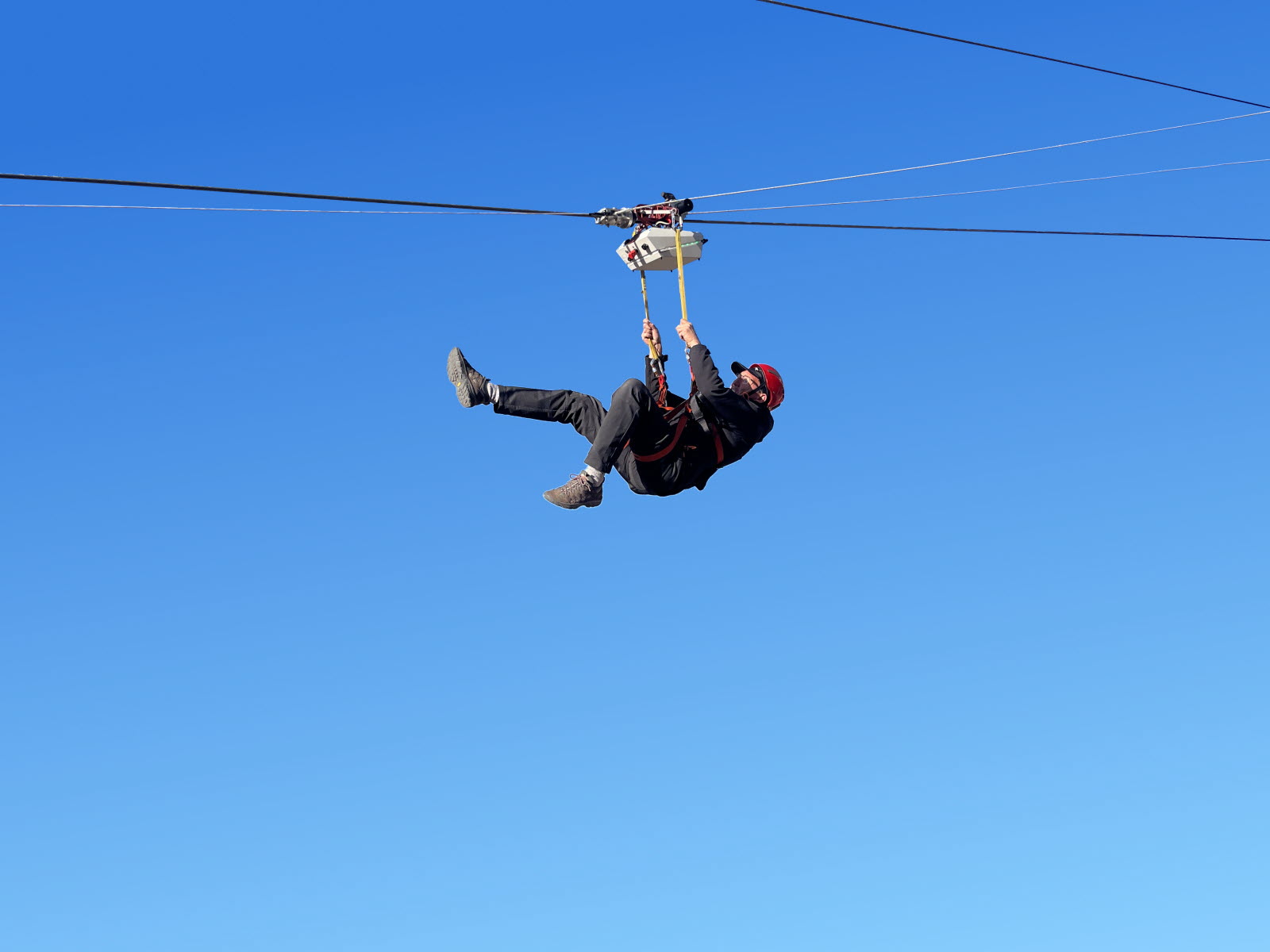
Behind a ride that feels smooth and effortless for the user, many variables come into play.
User weight can vary significantly, as can their position or behavior on the line.
External conditions are constantly changing: wind, temperature, humidity.
On top of that, there are strict safety requirements — especially regarding braking — as well as the realities of operations: throughput, staff organization, and handling unexpected situations.
A zipline is not a static system.
It is a constantly evolving environment.
Automating this type of system means handling very different situations… while maintaining reliable and consistent performance.
Braking, for example, cannot be “standard.”
It must adapt to different line profiles, loads, and changing conditions.
Energy management is also a constant balancing act:
recovering energy during descent while ensuring enough power to bring the trolley back in all situations.
Finally, control systems must account for the unpredictable:
a user who doesn’t reach the landing, a sudden gust of wind, or an unexpected variation in speed.
This is often the least visible aspect.
Every technical decision involves a trade-off:
Trying to optimize a single parameter can weaken the entire system.
Automation is not about adding a feature.
It is about finding the right overall balance.
When properly designed, an automated system fundamentally transforms operations.
Handling is significantly reduced.
Operations become smoother.
Risks linked to repetitive manual tasks decrease.
But automation does not eliminate constraints.
It shifts them.
Operators move from a physical role to a supervisory one.
Understanding the system becomes essential to ensure reliable operations.
Automating a zipline is not just about adding technology.
It means rethinking the entire system:
From rider behavior on the line to day-to-day operations.
And this is often where the success of a project is truly determined.
Automating a zipline may seem simple.
After all, it’s “just” about bringing a trolley back to the starting point.
On paper, the idea is straightforward. In reality, things are very different on site.